

Enjoy some Irish music while exploring our site!
MONUMENTS

Passengers & Crew of the Looshtauk
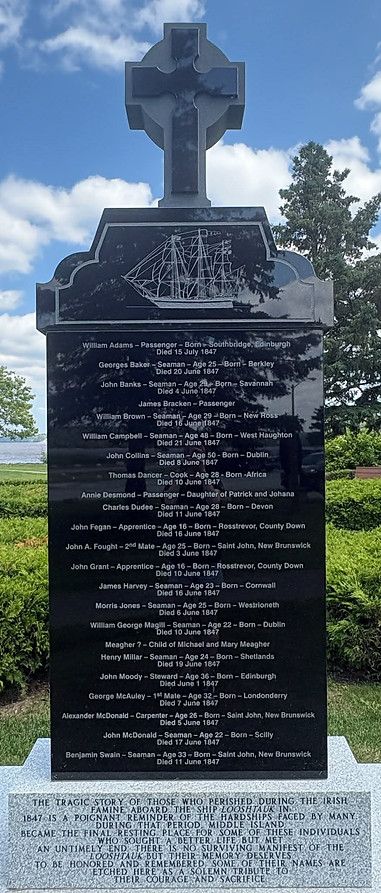
The tragic story of those who perished during the Irish Famine aboard the ship Looshtauk in 1847 is a poignant reminder of the hardships faced by many during that period. Middle Island became the final resting place for some of these individuals, who sought a better life but met an untimely end.
There is no surviving manifest of the Looshtauk but their memory deserves to be honoured and remembered. Some of their names are etched here as a solemn tribute to their courage and sacrifice.
Known Passengers & Crew of the Looshtauk
William Adams
Passenger – Born – Southbridge, Edinburgh – Died 15 July 1847
Georges Baker
Seaman – Age 25 - Born – Berkley – Died 20 June 1847
John Banks
Seaman – Age 29 – Born – Savannah – Died 4 June 1847
James Bracken
Passenger - son of James and Ann Bracken
William Brown
Seaman – Age 29 – Born – New Ross – Died 16 June 1847
William Campbell
Seaman – Age 48 – Born – West Thoughton – Died 21 June 1847
John Collins
Seaman – Age 50 - Born – Dublin – Died 8 June 1847
Thomas Dancer
Cook – Age 28 - Born -Africa – Died 10 June 1847
Annie Desmond
Passenger - Daughter of Patrick and Johana
Charles Dudee
Seaman – Age 28 – Born – Devon – Died 11 June 1847
John Fegan
Apprentice – Age 16 – Born – Rostrevor, County Down, Ireland – Died – 16 June 1847
John A. Fought
2nd Mate – Age 25 – Born – Saint John, New Brunswick – Died – 3 June 1847
John Grant
Apprentice – Age 16 – Born Rostrevor, County Down, Ireland – Died 10 June 1847
James Harvey
Seaman – Age 23 – Born – Cornwall – Died 16 June 1847
Morris Jones
Seaman – Age 25 – Born – Westrioneth – Died 6 June 1847
George William Magill
Seaman – Age 22 – Born – Dublin – Died 10 June 1847
Meagher ?
Passenger - Child of Michael and Mary Meagher
Henry Millar
Seaman – Age 24 – Born – Shetlands – Died 19 June 1847
John Moody
Steward – Age 36 – Born – Edinburgh – Died – 1 June 1847
George McAuley
1st Mate – Age 32 – Born – Londonderry – Died – 7 June 1847
Alexander McDonald
Carpenter – Age 26 – Born Saint John, New Brunswick – Died 5 June 1847
John McDonald
Seaman – Age 22 – Born – Scilly – Died – 17 June 1847
Benjamin Swain
Seaman – Age 33 – Born – Saint John, New Brunswick – Died 11 June 1847
Capt. John Mount Thain
Captain Thain was born in 1818 in Saint John, NB. In 1845 he began sailing as captain of the newly launched ship Looshtauk, built at Tynemouth Creek near Saint John, NB. On the 17 April, 1847, Captain Thain was assigned to sail the Looshtauk from Liverpool to Quebec. Five days into the voyage, symptoms of disease appeared among the passengers. Typhus and Scarlett Fever spread rapidly, causing Captain Thain to head for the nearest port – Miramichi. The Justices were totally unprepared for the magnitude of the disaster, and finally made the decision for Middle Island to be used as a temporary quarantine station. Captain Thain survived his illness after spending 27 days recovering on the Island, 15 of those in a state of insanity.
Dr. John Vondy
Dr. Vondy was born in 1820 in Bushville, NB. In 1842 he became a member of the Royal College of Surgeons of London, England. Dr. Vondy did not receive any special privileges while on the Island. For a man who so truly demonstrated his dedication to his profession, his accommodations were shameful. His own health was neglected and soon his frail body was no longer able to fight off the disease. Dr. Vondy died in his tent at the southwest end of the Island in July 1947 when he fell victim to a malignant fever on Middle Island.


.jpg)
Celtic Cross
The Celtic Cross was the first monument erected on the Island back in 1984. It was unveiled by Ireland’s Former Ambassador to Canada, the Honourable Sean Gaynor, and it was blessed by Most Reverend J. Edward Troy, Coadjutor Bishop of Saint John. An inscription on the back reads “bròn bròn mo bròn” in Irish Gaelic, accompanied by the English translation “sorrow sorrow my sorrow”.
At a later date, an engraved plaque was placed at the base of the Cross, it reads: “This Celtic Cross erected in memory of the Irish immigrants who died of typhus fever contracted during their voyage from Ireland on the Looshtauk in 1847 and are buried here. This Cross also commemorates the devotion of Dr. Vondy who while ministering to the victims, himself contracted the disease and died at the age of 28 years.”

Shamrock Hedges
The Shamrock Hedges were planted in 1988 by the Miramichi Irish Festival to encase the Celtic Cross while serving as further symbolism of the Irish heritage present on the Island.
An additional monument was added inside the Shamrock in 1997; a 150 year commemoration plaque, accompanied by a flagpole and the Irish Flag, as pictured above.
Split Potato Sculpture
The Split Potato was sculpted out of Kilkenny Limestone by Alison Bole of Monaghan County, Ireland. It was donated and commissionned by the Monaghan County Council in 2006. Monaghan County has been officially twinned with Miramichi, New Brunswick since 1999 to highlight their ancestral ties and Miramichi’s everpresent celebration of Irish culture and heritage.
The potato is split into two parts so that it appears to be cut in half. It represents the famine - this being the disaster that brought Irish emigrants on the famine ships to Middle Island. The split signifies how the lives of emigrants were cut in half by the famine, both halves are lying apart from each other to portray the journey accross the ocean and how it divided both parts of their lives. On one face is carved a shamrock to show where they came from and their Irish roots. On the other face is carved a maple leaf, to show their eventual integration into the Canadian Community. The Shamrock is carved onto the left hand piece as Canadians look to Ireland as being on their left (East).


Cairn
In 1993, a Cairn was erected by the Miramichi Irish Festival and dedicated to mark Middle Island as an Irish Famine Burial Ground. The engraved plaque reads “Middle Island 1847 Cemetery (Lazaretto) of Irish Famine immigrants.”

Provincial Historic Site Plaque
Middle Island was designated as a Provincial Historic Site in 1994 under the authority of The Historic Sites Protection Act. In 1995 a plaque was placed on the Island to designate the site. Along with a Fench translation, the plaque reads: “LANDING OF THE LOOSHTAUK 1847
The barque Looshtauk arrived at Middle Island with 462 Irish immigrants, more than half of whom did not survive. Despite this tragedy, such immigrant landings signal a turning point in the development of nineteenth-century New Brunswick.”
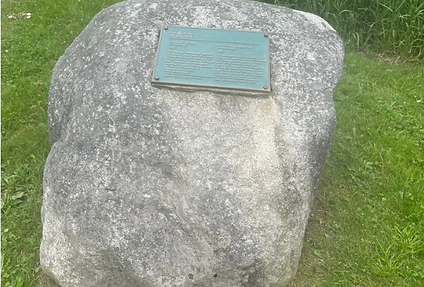

150 Years Commemoration Plaque
As the name suggests, this plaque commemorates the 150th anniversary of the Irish Famine victims’ arrival to Middle Island in 1847 on vessels Richard White, Looshtauk, Bolivar, Victoria, and Independence.
The plaque was placed inside the Shamrock’s peak along with a flagpole to fly the Irish Flag. All of these items were donated by the Miramich Irish Festival in 1997.


Commemorative Meadow
In 1997, a Commemorative Meadow was built by Middle Island Irish Historical Park in the shape of a large Celtic Cross. The walking trails that make up the shape of the Cross are outlined with stones, lending it the name Stone Cross.
MURALS
Island Quarantine

This mural reveals a very different Middle Island than the one you see today. With the arrival of the Looshtauk in 1847, this quiet Island erupted in activity. It quickly transformed into a quarantine station, becoming the only refuge for sick passengers as they struggled to stay alive. Take a closer look at life in quarantine on Middle Island: can you imagine fighting Scarlet Fever in an old fish shed or canvas tent?
Original Mural: David Daley
Original Sketch: Carmel McCarthy
This mural has since been painted over.
Middle Island, 1847
Mural: Allie Howe
Date: 2019

Barnaby River 1870
Not all immigrants quarantined at Middle Island perished. Those fortunate enough to stay alive were discharged to Chatham - their bodies weakened, but their spirits strong. Without food or fortune, many stayed in the town's hospital before settling into a homestead like the one seen here at Barnaby River. Finally able to plant their feet on Canadian soil, these resilient survivors farmed their way out of famine and into new, fruitful lives.
Mural: David Daley
Description: View of a Farm on the Barnaby River, NB.
Date: Circa 1870
Reference Photo: Canadian Archives (Intercolonial Railway). Public Domain Source: Library and Archives Canada/Francois-X. Labelle/PA - 022119
